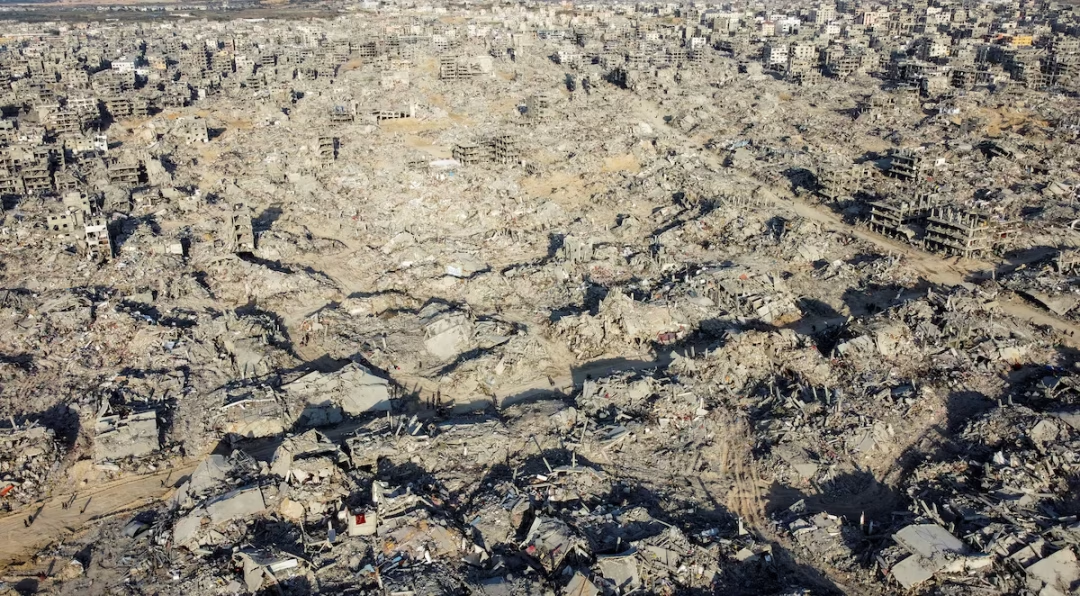
Photo of Jabalia in the Northern Gaza Strip, January 21. from REUTERS
This chapter was the hardest I have had to reread, bringing real mental anguish and pain. At best, laughing at the absurdity. On nearly every page, Kirsch distorts history, manipulates language, and omits key context. One point is crystal clear. In his view, anyone who seeks Palestinian liberation or even basic rights is treated as genocidal. His ultimate message is that the only acceptable option for Palestinians is to give up their lives, their land, and their struggle.
Take this example:
“Arab states came to a tacit acceptance of this fact in the 1970s, putting an end to decades of attempts to invade the Jewish state and wipe it off the map. The Palestinians have not, which is a major reason why the Israeli-Palestinian conflict continues, seventy-five years after the foundation of Israel and almost 150 years after Zionist settlement began.”
Kirsch’s claim boils down to blaming Palestinians for the ongoing conflict because they have not “accepted” Israel, while Arab states supposedly have. This is misleading. Some Arab states made peace decades later, but others did not, and many continue to support Palestinian rights. The statement also ignores Israel’s ongoing occupation, settlement expansion, and control over Palestinian land. By framing Palestinians as the main obstacle, Kirsch is essentially arguing that they must surrender entirely. This is the only solution he and the Zionist narrative consistently propose.
This chapter is perfect for dissection because it lays out a web of lies, manipulations, and erasures, many of which we face in daily narratives about Israel and Palestine. In this blog, I focus on the most absurd and consistent falsehoods, showing how they serve to justify oppression and erase Palestinian life.
The “No Mother Country” Myth
“Israel has no mother country obligated to defend it.”
“But the fact is that Israel’s 7 million Jews have no other home to go to.”
“Unlike the British in Kenya or the French in Algeria, the Jews had nowhere to return to.”
“If Israel falls, there is no empire waiting to retrieve its citizens.”
Kirsch uses this line to portray Israel as an isolated underdog, a small and lonely nation with no empire behind it. It sounds sympathetic, but it is completely false. Israel has had a mother country for decades: the United States. No other state on earth has received more cumulative military aid, diplomatic protection, or strategic partnership. U.S. veto power shields Israel at the U.N., American tax dollars fund its defense systems, and Western powers maintain its technological and economic edge. Calling that “no mother country” is dishonest.
Kirsch’s argument also obscures the deliberate nature of the Zionist project. The settlement of Palestine was intentional, organized, and by choice. These were not people stranded without options; they were participants in a political movement seeking to create a homeland through colonization. When he claims there was “nowhere to return to,” the truth is more complex. By the end of World War II, the Jewish population of Europe had been liberated by the victors. They were free citizens, not exiles. While legal and social barriers in some countries limited immediate migration, they were emerging from liberation, backed by the same powers that had redrawn the global order. Their settlement in Palestine was therefore not a flight from exile but a deliberate political and ideological choice.
If there is “no home to return to” now, it is because they made it so. The Zionist movement severed ties with the lands it left, both politically and culturally, to reinforce the claim that Palestine was the only possible destination.
This “no mother country” story also performs a victimhood inversion. It casts the colonizer as an orphaned survivor, vulnerable and abandoned, while Palestinians, the actual people made stateless, are erased. In reality, it is Palestinians who have no state, no army, and no empire to protect them. Israel, meanwhile, has more military strength and international backing than most countries on earth.
By pretending Israel stands alone, Kirsch creates emotional cover for its violence. The image of an isolated nation “fighting for survival” justifies anything, from preemptive strikes to indefinite occupation. But survival is not the issue here. Power is. Israel’s existence is not precarious; its domination is entrenched.
→ Flat falsehood: Israel does have a mother country, the United States, which has financed and defended it for decades.
→ Victimhood inversion: recasts the colonizer as a defenseless orphan while the occupied remain stateless.
→ Historical omission: hides the fact that Zionist movement was deliberate, not forced.
→ Moral distortion: uses the myth of isolation to excuse domination.
→ False inevitability: claims there is “nowhere to return to,” when that was a choice built into the project itself.
There is another layer to this machine that I just can’t get over. It is borrowed from the United States. What makes it noticeable is how Zionists cherry-pick the playbook AND hijack the language of dispossession. Israeli identity politics have merged with the struggles of truly oppressed people, especially Black Americans, as if they share the same history of loss and survival. At the same time, they operate as White AmericKa. #Cognitive Dissonance
That comparison is false and obscene. Black Americans had every trace of their identity, ancestry, and culture systematically erased, then sold back to them in fragments. In contrast, Israeli Jews know their history, religion, language, and lineage; the Holocaust, though unimaginably horrific, is also one of the most thoroughly documented events in human history. Holocaust survivors were liberated, granted reparations, encouraged to rebuild, and remembered across the globe, very sympathetically. They were not erased from existence or denied their past.
To claim the same or similar kind of dispossession is a form of mimicry of White AmeriKa’s intergenerational denial, especially because it involves blending their own history with the erased and stolen experiences of Black Americans.
So, when Israel and Zionists claims the same kind of dispossession or compares itself to people who had everything taken from them, it is not solidarity, empathy, or an innocent explanation. It is a mix of cognitive dissonance and hijacking. They’re using other oppressions to justify their own domination, turning ongoing oppression into a costume and calling it self-defense.
Rewriting Anti-Colonial History
“The left has long understood the Palestinian struggle… as an anti-colonial movement.”
He opens by framing the anti-colonial understanding of Palestine as a tired “leftist” idea, suggesting it’s just political fashion rather than historical reality. This move quietly primes the reader to see decolonization as ideology instead of fact. He does not contextualize why Palestinians, and almost every decolonial scholar in the world, describe their struggle that way: because it involves conquest, land seizure, displacement, and population replacement, which are the textbook features of settler colonialism.
Later he claims,
“This language of colonialism and decolonization has become a reflex on the left.”
By calling it a “reflex,” he reduces decades of scholarship, testimony, and lived experience to mere political habit. This is plain dismissal in an attempt to strip Palestinian history of its global context, as if their resistance exists in a vacuum.
He then tries to flip the script entirely, writing that,
“Israel is not an empire, nor a colony, but a refuge for an exiled people.”
This line attempts to recast colonization as return, turning an ongoing project of displacement into an act of survival. He is using semantic manipulation that erases Palestinians from the focal point and story altogether.
→ Tactic: delegitimizing a definition before addressing its evidence.
→ Effect: readers are taught to doubt the accuracy of “settler colonialism” meaningful analysis or criticism can even begin.
Sanitizing the Nakba as a Neutral Event
“Israel conquered the West Bank from Jordan and Gaza from Egypt, territories that had been occupied since 1948.”
He omits that these conquests created a permanent military occupation and mass displacement of Palestinians, resulting in a 15+ yearlong open-air PRISON. He never mentions UN Resolution 242 or international law violations.
Kirsch uses the word conquer, but strips it of meaning. He writes as if conquest is just geography changing hands. The phrasing “territories that had been occupied since 1948” is worse than insensitive, it’s a rewrite. He implies Israel was merely reclaiming land, not seizing and settling it. He never mentions that these “conquests” created permanent military control, mass displacement, or an apartheid system that has lasted decades and still defines daily life today. By skipping over the aftermath, he turns violent conquest into a neutral historical footnote.
Organizations like Human Rights Watch (2022) , Human Rights Watch (2023), and Amnesty International (2023)have documented how these occupied territories now function as open-air prisons, where millions live under military rule without freedom of movement or political rights.
There is no mention of UN Security Council Resolution 242 (1967), which explicitly calls for Israel’s withdrawal from the territories seized in the war. Nor does he acknowledge the Fourth Geneva Convention (ICRC, 1949), which prohibits the transfer of an occupying power’s civilian population into occupied land — a direct reference to Israel’s settlement expansion that began immediately afterward.
By flattening invasion into a neutral “territorial transfer,” he erases the ongoing reality of the Israeli settler colonial regime. The Nakba, the mass displacement of Palestinians that began in 1948, did not end; it evolved. What he presents as “security” or “defense” is, in practice, a continuous system of control and settlement designed to prevent return.
→ Omission and Erasure: erases the human cost, the legal record, and decades of international consensus.
→ Narrative control: uses seemingly objective language to turn invasion into a neutral cartographic update instead of an ever-unfolding catastrophe.
Whitewashing Zionist Colonization
“Jews went to Palestine in small volunteer groups… not backed by any government…”
That’s a half-truth. By the early 1900s, Zionist settlement was heavily funded by European capitalists and later the British Mandate. Claiming it was just “philanthropy” and “volunteerism” erases the colonial structure: land purchases under Ottoman absentee landlords, dispossession of tenant farmers, and British protection.
→ Lie by omission: he ignores how these early “self-sufficient” colonies depended on colonial land systems and British military control.
False Comparison to “Real Colonies”
“They were not drawn by resources… they were refugees, not colonizers.”
“The Jewish settlers were not driven by profit or greed but by survival.”
“If anything, they accepted lower wages and worse conditions in order to build a future for their people.”
Kirsch tries to redefine colonialism so narrowly, only as economic exploitation, that he can excuse Zionism entirely. That’s textbook weaponized incompetence: pretending not to understand the definition in order to “disprove” it. Settler colonialism isn’t specifically about chasing gold or sugar; it’s about control, occupation, dispossession, and replacement.
He sets up a false dichotomy where colonizers must either be exploiters or victims. But you can be both a refugee and a colonizer. Settler colonialism is a structure, not a motive, describing what happens/happening, not every conceivable reason why. When people arrive and displace an existing population to seize control, that’s colonization by definition, even if they call it refuge.
Kirsch’s framing collapses under scrutiny. These early Zionist settlers weren’t wandering aimlessly in search of safety. They went to Palestine deliberately and strategically, backed by organized movements, political lobbying, and European fundraising networks. They didn’t land there by accident. They saw a future there, spiritually, socially, and politically, and chose it.
And his claim that
“it wasn’t for a higher standard of living” is arbitrary and disingenuous. Religious freedom, self-determination, and safety from persecution are absolutely standards of better living. Pretending that only material wealth counts as “improvement” is a deliberate narrowing meant to make colonization sound virtuous. Not to mention that Palestine has desirable natural resources, especially oil and gas.
He also paints a strange picture where the settlers’ “lower wages” prove moral innocence, as though exploitation cancels out displacement. But accepting harder conditions doesn’t erase the reality that they were building a future through ownership and control of someone else’s land. It’s not martyrdom; it’s the infrastructure of colonization. In other words, enduring difficulty for the sake of taking someone else’s land doesn’t make a victim; it makes an agent of dispossession in a colonial system.
They weren’t escaping into exile; they were emerging from liberation. Backed by the victors of World War II, they advanced not as refugees but as inheritors of new geopolitical power and authority. They were constructing a state by design, fueled by ideology and ambition. His framing of them as reluctant victims is revisionism that recasts a deliberate project as destiny.
→ False framing: turns intentional colonization into reluctant refuge.
→ Misdirection: equates economic struggle with moral purity.
→ Omission: ignores that “a better life” includes freedom, sovereignty, and control…secured through Palestinian dispossession.
→ Weaponized incompetence: pretending to misunderstand the definition in order to “disprove” it.
→ False dichotomy: you can be a refugee and still participate in colonization. Settler colonialism is a structure, not a motive.
The “Refugee = Native”
“It is a country built by refugees.”
“Israel is a society of survivors, the descendants of those who were expelled and exiled, returning to their historic home.”
“In this sense, the Jews of Israel are more like the Algerians and Vietnamese, not their colonizers.”
“They were the displaced, not the displacers.”
Kirsch deliberately collapses “persecuted European Jews” into “native returnees,” equating exile with indigeneity. That erases Palestinian existence as the actual indigenous population.
This is what makes his claim so misleading. He turns suffering somewhere else into ownership somewhere new. The trauma of exile in Europe becomes a reason to settle in Palestine, as if being displaced once gives you the right to displace others.
Then he goes even further. Kirsch claims that Israeli Jews will fight
“like the Algerians and Vietnamese, not their colonizers.”
That comparison is ABSURD. The Algerians and Vietnamese were fighting against empires, not building one. The Algerians and Vietnamese were colonized peoples fighting for their own freedom. And unlike Palestinians, the Algerians and Vietnamese were not living in an open-air prison under military occupation. To compare occupying power (Zionist settlers), backed by European governments, to anti-colonial movements is a complete reversal of history, offensive, and makes the colonizer look like the victim.
→ Delusion and equivalency fallacy: he portrays Israeli Jews as “like the Algerians and Vietnamese”—which is grotesque inversion.
→ Historical inversion: recasts the colonizer as the decolonized.
→ Emotional manipulation: invoking the Holocaust to sanctify colonization and close moral debate.
→ Erasure: removes Palestinians from their own land and story, ignoring that Palestinians are still living under siege and occupation, not liberation.
Holocaust Redzone
“Being ‘driven into the sea’ would mean a second Holocaust.”
“is a euphemism for the murder of Israel’s Jewish population —not a “structural” or “cultural” genocide but an actual second Holocaust, perpetrated on the same people as the first one.”
“Calls for the end of the Jewish state are calls for the destruction of the Jewish people.”
“No other nation is asked to accept its own annihilation as a moral duty.”
Kirsch treats the Holocaust as an eternal present, as if Israel is still the powerless victim rather than the occupier. This framing protects the state, not the memory of the dead. Remembering the Holocaust should teach empathy and vigilance against all forms of oppression, not justify the oppression of another people.
He uses emotion to shut down criticism. By constantly invoking the Holocaust, he implies that people who suffered genocide cannot ever be oppressors. This is powerful language, but it is also manipulative. Jewish suffering is real and deserves remembrance, but it does not erase Palestinian suffering. Using tragedy as a moral shield keeps the story one-sided and untouchable.
Two things can be true at once: Jews faced horrific persecution in Europe, and Palestinians were displaced when Israel was created. Kirsch’s version of history leaves no room for both truths to coexist.
Here, Kirsch uses the Holocaust not as history but as a shield against accountability. He frames every Palestinian demand for liberation, equality, or return as a threat of extermination. The logic is simple and deeply manipulative: if Palestinians resist, they are plotting genocide. This turns every call for justice into an existential attack.
Rhetorical trap. It redefines Palestinian struggle as “Holocaust 2.0,” leaving no space for moral analysis or political discussion. If every critique of Israel equals antisemitism, and every demand for freedom equals annihilation, then debate becomes impossible. The trauma of the Holocaust is weaponized to silence conversation about current oppression.
Kirsch’s framing ignores the actual balance of power. Israel is not a stateless people facing annihilation. It is a highly developed state with one of the strongest militaries in the world, a nuclear arsenal, U.S. backing, and full control over Palestinian life. To claim that Palestinians—under occupation, blockade, and siege—pose an existential threat is dishonest and cruel. It erases the reality of who holds power.
He also ignores a basic truth: Israeli Jews know their history, their families, and their homes. They are not a scattered, endangered people without roots, or living under threat of extinction. They live in a country with overwhelming control, with the freedom, resources, and international protection to move or relocate if they ever chose to. The idea that they could be “banished into the sea” is not just unrealistic; it is propaganda designed to keep fear alive. It keeps Israelis in a permanent state of siege mentality, even as they are the dominant power.
→ Rhetorical trap: recasts all Palestinian resistance as “Holocaust 2.0.”
→ Fear narrative: keeps Israelis identified as victims despite being the regional power.
→ Dramatic lie: suggests Israelis could be “banished into the sea” as if anyone wants that at all in the literal sense…
→ Manipulation: turns historical trauma into political immunity.
→ Omission: he ignores Israeli military capacity, nuclear arsenal, and occupation power imbalance.
Turning Segregation into Virtue: The Myth of Moral Self-Reliance and Disguised Exclusion
“Jews did not exploit native labor but preferred to work the land themselves. This was a matter of principle and self-reliance.”
He treats Zionist exclusion of Palestinian labor (“Hebrew labor”) as moral purity instead of racial segregation.
Kirsch presents the Zionist policy of Hebrew labor, the deliberate exclusion of Palestinian workers from Jewish settlements, as a matter of noble moral choice and ethical virtue. He frames it as if Jews were simply committed to building their own communities. In reality, this policy was a structural form of segregation that intentionally blocked Palestinians from participating in the economy and limited their livelihoods.
By framing it as ethical self-sufficiency, Kirsch turns coercive economic control into a moral story. He tells half the truth. Yes, Jewish settlers labored themselves, but he omits the other half. Palestinians were systematically denied work, their farms disrupted, and their ability to earn a living undermined. This was not incidental. It was a deliberate strategy embedded in settlement practices.
→ Half-truth spun as virtue: a forced boycott of native labor is recast as admirable independence.
→ Omission: he doesn’t mention the systematic destruction of Palestinian agriculture, economic structures, and social networks caused by Hebrew labor policies.
→ Impact: Kirsch manipulates readers into sympathizing with Zionist settlement, making it appear ethically neutral if not exceptional, while it was a core mechanism of structural colonization.
Equal Numbers, Unequal Lives
“Today 7 million Jews and 7 million Arabs live between the Mediterranean Sea and the Jordan River, and this parity makes clear that settler colonialism does not apply.”
The symmetry in population is used to mask asymmetry in power.
Kirsch deliberately twists population numbers to claim Israel cannot be considered a settler-colonial state. This is misleading. Equal population does not equal power. Moreover, nearly half of Palestinians are children under 18 — about 43 percent overall, with 41 percent in the West Bank and 47 percent in Gaza (PCBS, 2023) — compared with 27.8 percent of children in Israel (Taub Center / Israel CBS, 2023).
The reality on the ground is far more extreme. Palestinians live in genocide under military occupation and blockade, trapped in what is effectively an open-air prison. They face constant bombardment, critical shortages of food and medical supplies, restricted access to clean water, limited mobility, daily harassment at checkpoints, and the regular destruction or restriction of homes, farms, and infrastructure due to settlement expansion and Israeli military control.
So yes, you might see “equal numbers (7 million Jews vs 7 million Arabs),” but you cannot ignore the vastly different conditions those populations live under. Israeli Jews enjoy secure homes, modern infrastructure, unrestricted movement, access to abundant resources and medical care, and the protection of a highly trained military with nuclear capabilities. The symmetry in population is used to mask the extreme asymmetry in power, resources, and security, hiding the brutal structural inequality and ongoing oppression Palestinians endure.
Since Kirsch wants to talk about statistics, why ignore the ones that actually tell the story of control and suffering: the death tolls, bombardments, starvation, weapons stockpiles, and decades of U.S. financial aid? Israel has the most advanced weapons of mass destruction in the region, decades of unmatched U.S. financial and military support (Council on Foreign Relations), and a disproportionate death toll inflicted on Palestinians over the last several decades (OCHA). Population numbers alone cannot capture this massive imbalance of power and control.
→ Statistical manipulation: Kirsch twists population numbers into a false moral equivalence, hiding the fact that one group wields total control over land, borders, resources, and military force.
→ Omission: He deliberately ignores the crushing reality of occupation, blockades, constant bombardment, starvation-level conditions, restricted movement, and overwhelming military and financial power.
→ Impact: Readers are coaxed into sympathizing with a fabricated sense of balance, while Palestinians endure life in a tightly controlled prison with little chance of a future.
Demonizing and Dehumanizing Palestinian Resistance
“72 percent of Palestinians approved of the October 7 attack…”
Kirsch cherry-picks this single poll and uses it to suggest that all Palestinian resistance is genocidal, implying that Israeli Jews face an existential threat. He provides no context. Gaza has been under decades-long siege, its population living under constant bombardment, trauma, and deprivation. He also ignores that “support for resistance” often does not equate to support for targeting civilians.
He goes further, claiming that “it hardly seems possible that Jews and Arabs who are mortal enemies under different governments would become good neighbors living under the same government. Nor is it likely that Hamas, which as a paramilitary group devotes so much effort to killing Jews, would be less interested in killing Jews or less effective at it if it ran a full-fledged state and military.” This is a massive lie. It portrays Palestinians as inherently genocidal while ignoring that resistance groups are not solely focused on killing. Many such groups engage in political organizing, social services, and community leadership. Kirsch also erases the long history of successful coexistence between Jewish and Arab Palestinians that has already occurred.
By framing Palestinians as barbaric and Jews as inherently moral or ethically neutral, he dehumanizes an entire population. This contrast reduces a complex society to a caricature of violence while casting one side as the civilized, virtuous actor. It is a deliberate moral inversion that manipulates readers into sympathizing with the settlers and fearing or distrusting Palestinians.
Kirsch also frames the potential return of Palestinian refugees and undoing 1967 as catastrophic, emphasizing that it would “erase Israel’s Jewish majority.” This implies that losing permanent dominance is inherently disastrous. He ignores the reality that not being a dominant majority is not genocide, nor is it morally wrong. Again, projecting a tired notion of “if it ain’t white, it ain’t right.” The not uncomfortable truth is that societies survive with changing majorities lol.
→ Propaganda tactic: Using fear statistics and sweeping generalizations to rationalize Israeli violence.
→ Moral distortion: Equating demographic change or potential power-sharing with existential threat.
→ Omission: Zero mention of Palestinian casualties, decades of blockade, or internal political complexity.
→ Narrative control: Positions Israelis as perpetual victims while presenting Palestinians as inherently violent, erasing historical context and structural power imbalances.
The “Auschwitz Borders” Appeal
“Does this offer any encouragement for returning to what the Israeli diplomat Abba Eban long ago called ‘Auschwitz borders’?”
Kirsch invokes Holocaust imagery yet again to argue that ending Israeli occupation or negotiating territorial compromise is equivalent to threatening Jewish extermination. He uses the weight of historical trauma to frame any discussion of Palestinian statehood or the right of return as morally impossible.
→ Emotional blackmail: equates political negotiation or ending occupation with genocide, pressuring readers to accept indefinite occupation as morally necessary.
→ Historical erasure: ignores that Israel’s pre-1967 borders were internationally recognized, functioned as actual boundaries for twenty years, and were accepted by the global community.
→ Distortion of context: omits decades of Palestinian displacement, occupation, and resistance, presenting Israeli territorial security as the sole moral and historical lens.
→ Weaponized trauma: uses the Holocaust to immunize policy from ethical scrutiny, conflating Jewish historical suffering with justification for ongoing structural domination.
Admitting Ethnic Cleansing, Then Normalizing It
“The original expulsion of refugees was necessary for a Jewish state to exist.”
This is an open acknowledgment of ethnic cleansing, but Kirsch frames it as inevitable or justified. He presents the forced displacement of hundreds of thousands of Palestinians as a “practical necessity” rather than a grave moral and legal violation.
→ Moral inversion: admitting the crime while justifying it as survival.
→ Weaponized fatalism: suggests coexistence was impossible, so violence was destiny.
→ Dehumanization: treats the expelled population as a barrier to state-building rather than as people with rights, history, and agency.
→ Erasure of accountability: frames historical violence as unavoidable, excusing policies that caused long-term suffering and displacement.
“Humane Elimination” Logic
“The humane answer… Jews could continue to live there, just not in a Jewish country.”
He caricatures one-state democracy as erasure of Jews, equating equal citizenship with annihilation.
“The humane answer is that they could continue to do so, just not in a Jewish country. Instead there would be a single state with roughly equal numbers of Jews and Arabs, at least to begin with. This solution has appealed to everyone from the liberal Jewish intellectual Tony Judt to Libya’s dictator Muammar Gaddafi, who in 2000 called for the creation of a new country called Isratine.”
He is basically and consistently expressing that giving Palestinians equal rights would be dangerous to Israeli Jews. Think about that for a second. If basic equality is somehow an existential threat, then something is seriously wrong with the system. Normal human rights, democracy, and equality are framed as genocidal…WTF!
The truth is the opposite. Israeli Jews already control the state, the military, the economy, and the borders. Equality would not harm them. By presenting fairness as “too dangerous,” Kirsch is defending ongoing genocide as if it’s the only moral choice.
→ False framing: democracy = destruction; equality = annihilation; occupation = safety.
→ Omission: erases Palestinian humanity, history of coexistence, and real democratic solutions.
→ Propaganda tactic: fear of equality justifies keeping millions trapped and unequal.
→ Underlying logic: permanent ethno-state is the only “moral” solution.
Bottom line: Kirsch’s logic is shocking. If equality would “destroy” Israeli Jews, then the problem is not the Palestinians at all.
The “Both Sides Extremes” Cop-out
“On both sides, religious and political extremists hope to expel or kill the other population. On both sides, these elements seem to have more momentum and passion than those working for peaceful coexistence.”
Kirsch frames the conflict as morally symmetrical, implying that Israeli and Palestinian actions are equally extreme. This delegitimizes Israel’s accountability because it ignores that Israel is the initiator, primary perpetrator, and active threat, controlling nearly all structural power including military, borders, resources, and governance, while Palestinians remain under occupation, blockade, restricted movement, and constant bombardment. By presenting “both sides” as equally responsible, he shifts blame away from the party actively enforcing oppression and turns structural violence into a story of mutual hatred.
→ False balance: equates state-level policy and occupation with the actions of a population under siege.
→ Narrative laundering: reframes a system of domination as inevitable tragedy.
→ Moral misdirection: encourages readers to sympathize with the powerful while blaming the oppressed.
Absurd Logic of Settler Victimhood
“But the actual effect of the ideology of settler colonialism is not to encourage any of these solutions. It is to cultivate hatred of those designated as settlers and to inspire hope for their disappearance. In this way, it abets Arab rejection of the State of Israel, which has helped to freeze the Israeli-Palestinian conflict in the same basic form since before 1948. The hope that Israel will prove to be a short-lived aberration, a historical curiosity like the Crusader kingdoms of the Middle Ages, condemns the Palestinians to political limbo, the Jews to aggressive hypervigilance, and both to dreams of a final solution in which the enemy simply disappears. Insofar as the ideology of settler colonialism nourishes such dreams, it helps to ensure a worse future for everyone living ‘between the river and the sea.’”
Kirsch is wildly off base. He literally blames an analysis of colonization—not the occupation, not settlements, not military control—for the ongoing conflict. He paints Palestinians as obsessive schemers hoping for Israel’s disappearance, while turning settlers into hypervigilant victims of theory itself. This is absurd on multiple levels: the idea that pointing out oppression “causes” hatred is the intellectual equivalent of blaming a mirror for reflecting an ugly truth.
He frames structural violence and decades of occupation as if the only problem is how Palestinians think about it. Palestinians are cast as irrational aggressors while settlers are painted as moral guardians constantly under siege from imaginary threats. He literally suggests that hopes for a fairer, post-colonial future somehow “ensure a worse future” for everyone, as if equality and justice are catastrophic. This is moral contortion, intellectual acrobatics, and propaganda all rolled into one.
→ Absurd moral logic: equality and justice are treated as catastrophic threats rather than fundamental rights.
→ Gaslighting on steroids: The real drivers of conflict—land theft, occupation, and systemic oppression—are ignored while the theory that explains them is blamed.
→ Reversal of reality: The oppressors become the victims of critique, the oppressed are depicted as aggressors in thought alone.
→ Logical collapse: He paints Palestinians as scheming for a “final solution” while the very ongoing structure of Israeli settler colonialism is genocidal.
→ Narrative insanity: This argument makes the analysis of historical reality sound like a dangerous ideology rather than a tool to understand ongoing oppression, leaving readers bewildered and misled.
→ Impact: readers are misled to sympathize with the absurd idea that settlers’ paranoia is rational and inevitable, while the lived reality of Palestinians under occupation is normalized and erased.
Discover More (Triggering)
IDF War Crimes and Sentiments:
Note:
“These animals can no longer live” says Israel’s oldest reservist
See video evidence of Israeli soldiers destroying Gaza
Israeli settlers block aid trucks to Gaza
Israeli settlers attack Palestinian workers
Israeli students chant ‘may their village burn’
Israelis sing racist chants at Palestinians during ‘Flag March’ in Jerusalem
Like and Subscribe!
Gia, your response to Kirsch’s chapter is powerful and deeply analytical, offering a well-researched critique that exposes how his arguments distort history and language to justify oppression. You do an excellent job unpacking the mechanisms of manipulation, showing how Kirsch reframes colonization as refuge, oppression as survival, and equality as destruction. The way you highlight his omissions, such as ignoring international law and the structural realities of occupation, strengthens your case and underscores the imbalance of power that he deliberately conceals. I especially appreciate how you reveal the inversion of victimhood, where Palestinians are portrayed as aggressors while Israel’s dominance is sanitized. Your discussion of “weaponized trauma” through the constant invocation of the Holocaust adds depth and emotional clarity, making this an incisive and necessary critique of propaganda disguised as scholarship. Excellent work!