Image by Culture Club/Getty Images
In this series, we break down the Willie Lynch Letter section by section to explore its ideas, impact, and continued relevance. This post focuses only on the introduction, analyzing why it remains significant
The letter is short, and many online versions are incomplete or truncated. Therefore, I am including the full text of each section from the 2014 edition I own. You will first read the original text verbatim, followed by my personal analysis and commentary.
Introduction
The infamous “Willie Lynch” letter provides a great deal of insight into the brutal and inhumane psychology behind the African slave trade. The materialistic viewpoint of Southern plantation owners was slavery was a “business” led to slave victims being treated as merely subhuman pawns in an economic game of debauchery, crossbreeding, interracial rape and mental conditioning.
There were considerable debates during the colonial periods in the United States, and the late 1700’s, the attention of the national government was mainly directed to slavery and the rising numbers of slaves traded and imported into the South. The moral questions were also argued back and forth, but there were no question of the tremendous profitability using slavery in exchange for molasses, sugar, textiles, spices, and the massive free Labor of the cotton production on numerous plantations in the South. The system began with a conspiratorial battle of wits between the European traders and African chiefs.
Slave traders were required to know not only the state of the trade, if they were to “see a profit, but also know the likely supply of slaves available on one hand, and the likely supply of ships on the other. Also the varying values of many different standards of payment. Coins were seldom or never used on the coast. Mostly the chiefs and slave traders dealt in rolls of tobacco, barrels of rum, and firearms and generally in lengths of iron or copper, or in pots and basins of brass. The slaver’s books are full of all of this.
Regardless of the economic prosperity enjoyed during the African slave trade, and the tedious burden placed on the backs of African people, most will agree that the psychological damage and atrocities inflicted on Black people during that point of time some of the most truly outrageous examples of injustice and oppression ever experienced by humanity. The Willie Lynch letter, though painful to read, provides important documentation of the cruel mentality exercised by slave traders and owners of his day.
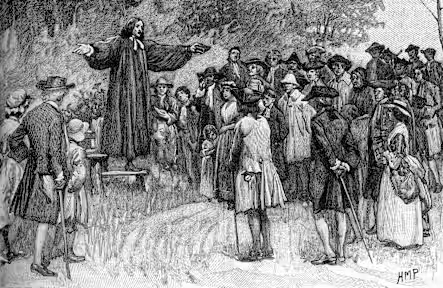
This speech was delivered by Willie Lynch on the bank of the James River in the colony of Virginia in 1712. Lynch was a British slave owner in the West Indies. He was invited to the colony of Virginia in 1712 to teach his methods to slave owners there. The term “lynching” is derived from his last name (Lynch, 2014, pp. 5–6).
The Willie Lynch Letter claims to be a 1712 speech on controlling enslaved Africans, but historians have proven it to be fake. No record of Willie Lynch exists, and the language clearly comes from the late twentieth century, likely the 1970s or 1980s. Still, the letter refuses to die because it captures the mentality of dehumanization and exploitation perfected in America. Division, fear, and psychological manipulation were deliberate, intentional tools of domination that shaped slavery and the society that grew from it.
I believe the letter is still worth studying. It is not a historical artifact, but a mirror reflecting the enduring psychology of colonialism and racial capitalism. Studying it reveals how the same ideas of division and manipulation continue in different forms today. The letter exposes truths that history books often ignore, showing that slavery was not only about labor but about deliberately breaking unity, identity, and self-worth. It serves as a reminder that the deliberate sentiments which built the system still exist and must be recognized and unlearned.